By Aangan Editorial · Published and sources checked
Plywood versus MDF is only the beginning of a wardrobe specification. The board product, panel thickness, door construction, finish, hardware and installation details all need to be identified. Ask for a proposal you can compare line by line instead of choosing from a generic “premium board” label.
Identify the board product and intended application
Greenpanel’s pre-laminated MDF range includes interior, exterior and HDWR variants. The manufacturer lists furniture and wardrobe applications, but the precise variant remains part of the specification. Do not treat every MDF product as identical. Greenpanel: pre-laminated MDF ranges.
Product names are not a substitute for the stated grade. CenturyPly’s current Sainik 710 page describes that product as complying with IS 303 BWP. Record the actual technical description supplied for the product, rather than inferring a standard from a number in the name. CenturyPly: Sainik 710 product specification.
| Decision | Plywood proposal | MDF proposal |
|---|---|---|
| Board identity | Ask for manufacturer, product, grade and thickness for every part. | Ask for manufacturer, exact variant, grade and thickness for every part. |
| Panel role | Separate carcass, doors, shelves and back panel. | Separate carcass, doors, shelves and back panel. |
| Finish and edges | Identify surface finish, back face, edge treatment and cut-outs. | Identify pre-finished or applied surface, back face, edge treatment and cut-outs. |
| Hardware and loading | Request compatible hinges, drawer runners, shelf supports and design checks. | Request compatible hinges, drawer runners, shelf supports and design checks. |
| Site and installation | Record wall condition, fixing method and site constraints. | Record wall condition, fixing method and site constraints. |
Review the complete assembly
Ask the designer or fabricator to show the wardrobe as components: sides, shelves, doors, back, drawers and supports. Note long shelves, tall shutters and heavy stored items. Have the proposed construction checked for the actual size and use; the board name alone does not resolve those details.
If a wall has a moisture problem, request investigation and resolution before installing furniture against it. A product’s resistance claim does not diagnose the building or define a complete installation. Obtain the technical sheet, care guidance and the written terms applicable to the supplied product.
Compare samples and installed scope
Examine a finished sample with its edge and back visible, rather than only a decorative swatch. Ask how handles, hinges, internal drawers and lighting are integrated. Compare the same wardrobe dimensions and internal arrangement before considering the price difference.
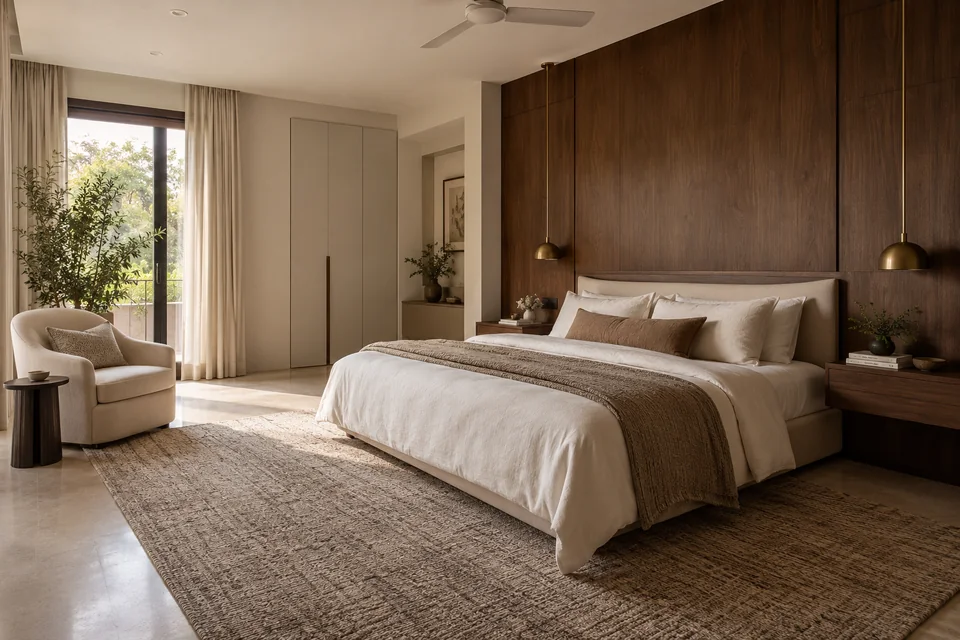
Include transport, installation, making good, adjustments and exclusions in both proposals. Keep the approved sample reference and specifications with the drawing revision. Our appearance references can help describe colour and arrangement, but cannot identify a board hidden inside an AI-generated wardrobe.
Questions before you decide
Is plywood always better than MDF?
That statement is too broad for a specific wardrobe. Compare identified products and have the complete assembly assessed for dimensions, loads, finishes, site conditions and intended use.
Does a waterproof product name solve a damp wall?
No. A board specification does not replace investigating and resolving moisture affecting the building or defining the installation details.
What should the quote say?
Identify the manufacturer, product, grade, thickness and role of each board, together with finish, edges, hardware, dimensions and installation scope.